India Women’s National Cricket Team Vs England Women’s National Cricket Team Stats
India Women’s National Cricket Team Vs England Women’s National Cricket Team Stats
Table of Contents
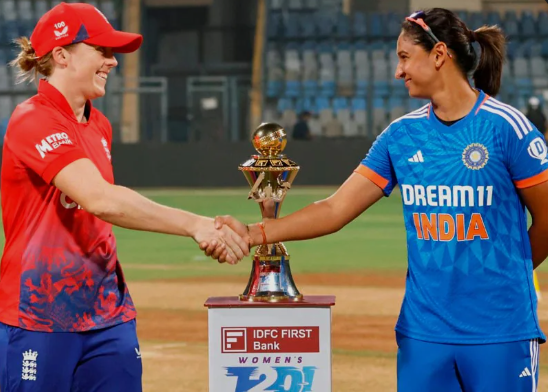
The India Women’s National Cricket Team and the England Women’s National Cricket Team has grown into one of the most competitive matchups in women’s cricket. From England’s early dominance to India’s rise as a fearless and skilled unit, the contests have delivered unforgettable scorecards, pressure-filled chases, and standout individual performances. Over the years, both teams have pushed each other tactically and mentally, producing closely fought ODIs, T20Is, and World Cup clashes. This rivalry is no longer one-sided but a balanced battle shaped by evolving talent, aggressive strategies, and rising global attention on women’s cricket.
Latest Matches
Date
Format
Venue
Winner
Margin
Key Performers
25 May 2026
T20
Chelmsford
India Women
7 Wickets
Ind: 200/6; Eng Dev XI: 154/6
19 Oct 2025
ODI
Indore
England Women
4 Runs
Knight (109), Deepti (4/51, 50)
25 Sep 2025
ODI
NCA Bangalore
England Women
152 Runs
Sciver-Brunt (122), Lamb (81)
22 Jul 2025
ODI
Chester-le-Street
India Women
13 Runs
Harmanpreet (143), Sciver-Brunt (122)
19 Jul 2025
ODI
Lords
England Women
8 Wickets
Ecclestone (Match-winning spell)
Current Squad Comparison Table
Feature / Category
India Women Squad
England Women Squad
Captain
Harmanpreet Kaur
Nat Sciver-Brunt
Vice-Captain / Deputy
Smriti Mandhana
Charlie Dean
Key Batters
S. Verma, J. Rodrigues, B. Fulmali
H. Knight, D. Wyatt-Hodge, S. Dunkley
Primary Wicket-keepers
Richa Ghosh, Yastika Bhatia
Amy Jones
Frontline Spinners
Radha Yadav, Shreyanka Patil, K. Gaud
S. Ecclestone, L. Smith, T. Corteen-Coleman
Frontline Pacers
Renuka Singh Thakur, Arundhati Reddy
Lauren Bell, Lauren Filer, Issy Wong
Top Players Comparison Table
Player Name (Team)
Speciality
Key Statistical Highlight vs Opponent
Career Standing / Role
Smriti Mandhana (IND)
Opener
999 All-Format Head-to-Head Runs
Critical technical anchor
Harmanpreet Kaur (IND)
Middle Order
Highest individual score of 143
Power hitter and Captain
Deepti Sharma (IND)
All-Rounder
32 wickets and consistent lower-order runs
Primary spin option
Nat Sciver-Brunt (ENG)
All-Rounder
785 Head-to-Head Runs and multi-wicket spells
Elite global all-rounder
Sophie Ecclestone (ENG)
Left-arm Spin
37 head-to-head wickets
Top-ranked defensive spinner
Danni Wyatt-Hodge (ENG)
Opener
618 T20 Head-to-Head Runs
High strike-rate baseline
Playing XI Comparison Table
Batting Order
India Women Projected XI
England Women Projected XI
1
Smriti Mandhana
Danni Wyatt-Hodge
2
Shafali Verma
Tamsin Beaumont
3
Yastika Bhatia (wk)
Alice Capsey
4
Harmanpreet Kaur (c)
Nat Sciver-Brunt (c)
5
Jemimah Rodrigues
Heather Knight
6
Deepti Sharma
Amy Jones (wk)
7
Richa Ghosh
Sophia Dunkley
8
Shreyanka Patil
Charlie Dean
9
Radha Yadav
Sophie Ecclestone
10
Arundhati Reddy
Linsey Smith
11
Renuka Singh Thakur
Lauren Bell
Head-to-Head Player Battles Table
Batter (Team)
Bowler (Team)
Tactical Dynamic
Notable Matchup Data
Smriti Mandhana (IND)
Sophie Ecclestone (ENG)
Left-arm orthodox restriction vs aggressive left-hand opener
Ecclestone has checked Mandhanas strike rate in standard powerplays
Harmanpreet Kaur (IND)
Charlie Dean (ENG)
Off-spin matchup vs cross-bat sweep strategies
Kaur looks to target Dean over the leg side; Dean relies on drift
Nat Sciver-Brunt (ENG)
Deepti Sharma (IND)
Battle of the premier all-rounders in the middle-overs
Deepti varies pace to counter Sciver-Brunts dynamic crease movement
Danni Wyatt-Hodge (ENG)
Renuka Singh Thakur (IND)
Swing bowling vs high-intent powerplay hitting
Renuka early inward movement frequently threatens Wyatts inside edge
Early Rivalry Scorecard and Player Impact Phase
The early phase of the india women’s national cricket team vs england women’s national cricket team stats rivalry was heavily shaped by England’s experience and India’s learning curve in international women’s cricket. England’s disciplined bowling attack often exposed India’s inconsistent batting lineup, especially in English conditions where swing played a major role. Players like Charlotte Edwards and Katherine Brunt dominated early scorecards with control and precision. India relied heavily on Mithali Raj’s stability and Jhulan Goswami’s emerging fast bowling threat. Despite frequent losses, India showed glimpses of resilience through partnerships that slowly built confidence. These early matches laid the foundation for a rivalry that would grow in intensity, skill level, and global attention over the years.
Season
Score Summary
Winning Team
Key Performance
Standout Player
2002-05
ENG 3-0 IND
England
Bowling dominance
Katherine Brunt
2006-09
ENG 4-1 IND
England
Top-order control
Charlotte Edwards
2010-12
ENG 3-2 IND
England
Close ODI battles
Mithali Raj
2013-15
ENG 4-2 IND
England
Spin impact rise
Jhulan Goswami
Player Battles and Tactical Evolution Phase
The india women’s national cricket team vs england women’s national cricket team stats rivalry entered a more competitive phase when India began closing the gap in skill and strategy. This period saw intense player battles, especially between Mithali Raj and England’s pace duo of Brunt and Shrubsole. India’s batting lineup became more structured, while England adapted a more tactical approach in limited overs formats. Smriti Mandhana’s arrival added aggression at the top, changing how India approached powerplays. England still maintained an edge in finishing matches, but India’s improved middle-order resilience made contests far more competitive. These years marked the shift from one-sided dominance to a more balanced rivalry.
Season
Score Summary
Winning Team
Key Performance
Standout Player
2016
ENG 2-1 IND
England
ODI competitiveness rises
Smriti Mandhana
2017 WC
ENG win
England
Knockout pressure control
Nat Sciver
2018
IND 2-1 ENG
India
Historic series win
Harmanpreet Kaur
2019
ENG 3-2 IND
England
Tight T20 finishes
Sophie Ecclestone
ICC Tournament Pressure Matches and Key Moments
In ICC tournaments, the india women’s national cricket team vs england women’s national cricket team stats rivalry reached its highest intensity. World Cup and T20 World Cup clashes brought immense pressure, where every over carried global significance. England often relied on Nat Sciver-Brunt’s consistency and Ecclestone’s spin control, while India depended on Harmanpreet Kaur’s explosive innings and Deepti Sharma’s all-round balance. These matches featured dramatic collapses, late recoveries, and game-changing partnerships. England held a slight psychological edge in knockout scenarios, but India consistently pushed them to the limit. These encounters shaped the modern identity of the rivalry as one defined by high stakes and emotional swings.
Season
Score Summary
Winning Team
Key Performance
Standout Player
2017 WC
ENG win SF
England
Knockout pressure mastery
Nat Sciver
2022 WC
ENG win
England
Chase control under pressure
Ecclestone
2023 T20
IND win
India
Aggressive batting burst
Harmanpreet Kaur
2024 Series
ENG 2-1 IND
England
Balanced team dominance
Heather Knight
T20 Powerplay Battles and Modern Aggression Era
The T20 format brought a new dimension to the india women’s national cricket team vs england women’s national cricket team stats rivalry. Matches became faster, more aggressive, and heavily dependent on powerplay performance. Smriti Mandhana and Shafali Verma provided explosive starts for India, while England responded with strategic bowling changes and spin control through Ecclestone and Glenn. The middle overs often decided matches, where strike rotation and wicket control became crucial. Both teams adapted modern T20 strategies, focusing on higher scoring rates and flexible batting orders. This era produced several close finishes, reflecting how evenly matched both sides had become in short-format cricket.
Season
Score Summary
Winning Team
Key Performance
Standout Player
2020
ENG 2-1 IND
England
Powerplay control
Ecclestone
2021
IND 2-1 ENG
India
Fast starts dominance
Shafali Verma
2022
ENG 3-2 IND
England
Death overs execution
Nat Sciver
2023
IND 2-2 ENG
Draw
Balanced T20 rivalry
Mandhana
Changing Spells Phase
Bowling performances have consistently shaped the india women’s national cricket team vs england women’s national cricket team stats rivalry. Jhulan Goswami’s swing bowling often troubled England’s top order, while Katherine Brunt’s aggression tested India’s batting resilience. In modern cricket, Sophie Ecclestone emerged as a key match-winner with her control in spin-friendly conditions. Deepti Sharma provided India with crucial breakthroughs in middle overs. Many matches swung dramatically due to bowling spells rather than batting collapses or heroics. These performances highlight how both teams built strategies around controlling phases of the game through bowlers rather than pure batting strength.
Season
Score Summary
Winning Team
Key Performance
Standout Player
2015
ENG 3-2 IND
England
Seam bowling impact
Brunt
2018
IND 2-1 ENG
India
Spin control dominance
Deepti Sharma
2021
ENG 2-1 IND
England
Death bowling precision
Ecclestone
2024
IND 1-1 ENG
Draw
Balanced bowling attack
Jhulan Goswami
Conclusion
The India Women vs England Women stands as a symbol of how women’s cricket has evolved into a high-intensity international spectacle. What began as uneven contests has transformed into tightly contested battles decided by small moments of brilliance. Both teams have produced match-winning stars, memorable innings, and game-changing spells across formats. As the rivalry continues to grow, each new series adds more depth to their shared history. Fans now expect drama, skill, and unpredictability every time these two sides meet, making this one of the most exciting rivalries in modern women’s cricket.

Leave a Reply